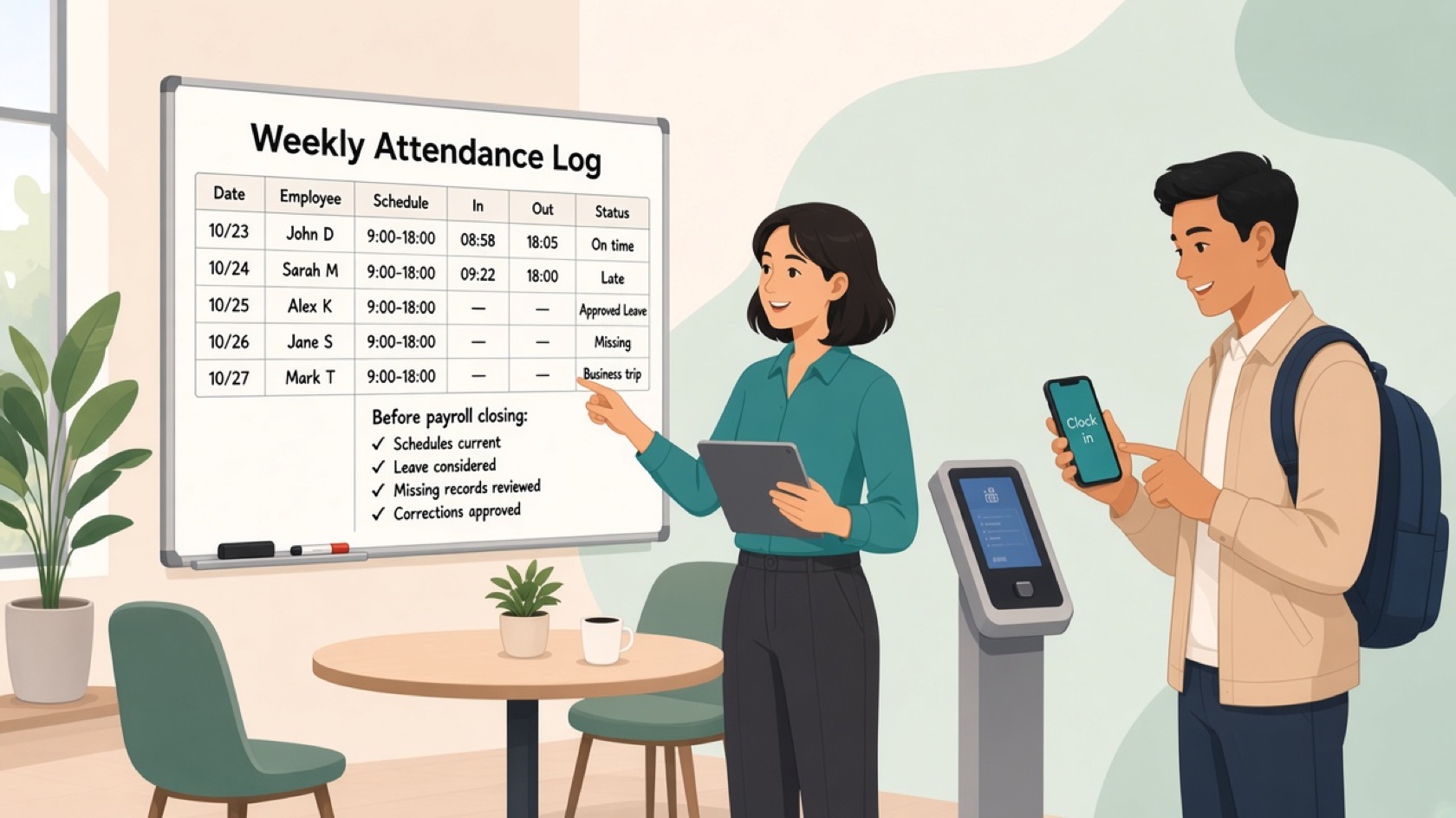
Practical guidance for creating clearer, more accurate and more consistent attendance processes.
Attendance management is more than recording when employees arrive and leave. Companies also need clear rules, accurate schedules, timely information and a reliable way to review attendance issues.
When these elements work together, employees understand what is expected, managers can respond faster, and HR can prepare more reliable information for payroll.
1. Set Clear Attendance Rules and Responsibilities
Employees should understand:
- Their assigned working hours and schedules
- When and how to clock in and clock out
- How breaks, lateness and early departures are handled
- What to do when an attendance record is missing
- How to record fieldwork, business trips and off-site assignments
- How to request leave, overtime or attendance corrections
- Who to contact when they cannot report to work
Responsibilities should also be clear. Employees record their attendance and report problems. Supervisors review their teams’ records and requests. HR maintains the rules, monitors unresolved issues and prepares verified information for payroll.
Attendance rules should be introduced during onboarding and remain available for employees and managers to review.
2. Choose Attendance Methods That Fit the Workplace
There is no single attendance method that is suitable for every employee, location or type of work.
Depending on the workplace, companies may use:
- Fingerprint or facial-recognition terminals
- Employee identification cards
- QR codes
- NFC-enabled devices
- Mobile clock-in with location verification
- Web-based attendance
- Manual attendance forms
- A combination of different methods
Companies can choose different methods for different groups. Office employees may use mobile or web-based attendance, while factory employees use fingerprint or facial-recognition terminals. Field employees may use mobile clock-in with location verification.
The method may differ, but the attendance rules and review process should remain consistent.
Companies with controlled entrances may also connect attendance with door or gate access. However, entering a workplace does not always mean that work has started. If access records are used for attendance, the company should clearly define how entry, exit, breaks and temporary departures are treated.
Make Attendance Information Available Promptly
Regardless of the method, clock-in and clock-out information should be available in real time or as soon as reasonably possible.
This helps authorized managers and HR:
- Confirm whether employees have reported to work
- Identify missing clock-in or clock-out records
- Notice lateness or unexpected absences
- Detect device or synchronization problems
- Follow up before the issue becomes difficult to verify
- Make faster staffing and operational decisions
Notifications can also alert the appropriate person about missing records, late arrivals or failed synchronization.
If a device temporarily operates offline, it should retain the records and synchronize them when connectivity returns. The company should also maintain a backup process for device, power or internet interruptions.
3. Keep Work Schedules Accurate
Attendance records cannot be interpreted correctly when employee schedules are missing or outdated.
Companies should keep the following information current:
- Assigned workdays
- Starting and ending times
- Shift assignments
- Rest days and public holidays
- Temporary schedule changes
- Approved shift exchanges
- Field assignments and business trips
HR does not always need to prepare every schedule. Authorized supervisors, store managers or department managers can prepare schedules for their own teams within the company’s rules.
Employees may also submit requests for schedule changes, preferred working times or shift exchanges. These requests should still be reviewed and approved before the final schedule changes.
A structured scheduling process can reduce repeated communication and administrative work while keeping schedule changes controlled and visible.
4. Review Attendance with Connected Information
A clock-in record alone does not fully explain an employee’s attendance status.
Managers and HR should review attendance together with:
- The employee’s work schedule
- Approved leave
- Approved overtime
- Missions, field assignments or business trips
- Rest days and public holidays
- Approved attendance corrections
For example, an employee without a clock-in record may be on approved leave, working off-site, on a rest day or observing a public holiday. If none of these applies, the missing record may require follow-up.
A consolidated attendance log report can support this review by identifying:
- Late arrivals and early departures
- Missing clock-in or clock-out records
- Employees with no attendance records
- Records with an approved explanation
- Attendance issues that remain unresolved
Managers and HR should be able to review the information by date, employee, department, location and attendance status. This makes it easier to focus on records that require follow-up.
Reviewing attendance with connected information reduces unnecessary follow-up and helps the company resolve genuine issues before payroll processing.
5. Control Corrections and Prepare for Payroll
Employees may occasionally forget to clock in, use the wrong method or experience a technical problem. Companies therefore need a clear correction process.
An attendance correction should record:
- The date and time requiring correction
- The corrected information
- The reason for the correction
- The person requesting the change
- The person reviewing or approving it
- Supporting information, when necessary
Employees should not directly change final attendance records without approval. Managers should also avoid making unexplained changes on behalf of employees.
Before payroll processing, HR should complete a final review to confirm that:
- Attendance records for the period are complete
- Missing records have been investigated
- Leave, overtime and schedule changes are approved
- Missions and business trips have been considered
- Corrections include reasons and approvals
- Remaining issues have responsible persons and deadlines
A clear payroll cut-off date should be communicated to employees and managers. Late corrections should follow a defined process rather than being handled informally.
6. Use Attendance Information to Improve Operations
Attendance information should help the company improve—not only identify individual problems.
Management can review patterns such as:
- Repeated missing attendance records
- Frequent lateness within a department
- High levels of overtime
- Scheduling difficulties
- Problems at a particular location
- Frequent attendance corrections
- Devices or clock-in methods that regularly fail
- Issues that remain unresolved until payroll closing
These patterns may indicate unclear rules, staffing difficulties, poor scheduling, technical problems or insufficient communication.
The goal should be to understand the cause and improve the process, not simply to punish employees.
A Quick Attendance-Management Checklist
Before payroll closing, confirm that:
- Employee schedules, shifts, rest days and public holidays are current
- Attendance devices and other clock-in methods have synchronized their records
- The attendance log report contains complete clock-in and clock-out information
- Leave, overtime, missions and business trips have been considered
- Late arrivals and missing records have been reviewed
- Missing records with approved explanations are separated from unresolved issues
- Corrections include reasons and required approvals
- Final attendance information has been reviewed before payroll processing
Better Attendance Management Starts with a Clear Process
Companies do not manage attendance better simply by installing a new device or asking employees to clock in more carefully.
Better attendance management comes from combining suitable recording methods, timely information, accurate schedules, connected records and clear review responsibilities.
When the process is well organized, employees know what is expected, managers can respond earlier, and HR and payroll teams can work with clearer and more reliable information.
Note: This article provides general attendance-management guidance. Organizations should review their practices against applicable Cambodian employment requirements, internal policies and professional advice where necessary.